Hal Fan Hour

  • Subscribe to our RSS feed.
  • Twitter
  • StumbleUpon
  • Reddit
  • Facebook
  • Digg

Thursday, 4 April 2013

International Perspective: The MOOC and Campus-Based Learning

Posted on 11:58 by Unknown

Summary of a presentation by Phillip D. Long, University of Queensland


Role of the University:

- Drew Faust, Harvard: it’s not really about what’s happening term by term or even graduatiomn, but it’s about the experience with us that shapes their life long learning and which transfers a culture one generation to the next.

- By contrast, the view of the role of the university as a function of the economic system, to drive economic wealth. Eg. Australia’s Chief Scientist Robin Batterham.

The impact of technology is one of diasaggregation.


Technology is splitting off, for example, assessment into different modes of doing it. And then learning is split into doing it online, on campus, in a MOOC, all in the background for many of leveraging personal learning environments.

Our campus at UQ is like yours I suspect. The campus is tradition in that most students bring technology for themselves. What may be different is the extent in which the LMS on campus is affecting the social experience on campus. We actually have more people logged on online concurrently than physically we have on campus.
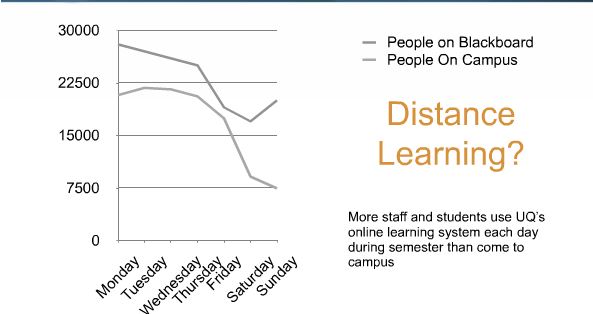


The access to the LMS and services on campus is documented here – they access the LMS more than they access their own Facebook accounts. That’s part of the cultural context we find ourselves in.

What we find absolutely pervasive in Australian institutions is that every class with more than 50 students is automatically recorded (with Lectopia). The experience of the majority of students is through lecture capture. We are effectively doing distance learning whether we meant to or not.

(Nathaniel Ostashewski @ Curtin University of Technology: Lecture capture in Australia also allows for many students who are working and cannot attend campus to access the lectures. At least in our University - which is very different from North America. )
So that’s the background, the context.

A little history.

The MOOC space begins in a context 11 years ago with MIT OpenCourseWare. Another significant marker was when Berkeley put up its lectures in iTunes. And then the Khan Academy came along and began putting up videos on YouTube. And then 18 months ago Stanford came along. Now it’s MOOC-mania.

(SD - a real history of the MOOC: https://sites.google.com/site/themoocguide/  )

What we find in Australia is more a reaction to the opportunity. Here’s a series of presentations and postings on MOOCs from ‘the Conversation’. One institution in Australia had joined Coursera (Melbourne). There were concerns about the North American invasion.

We’ve seen this all before, maybe. The technology context and the setting has changed in this third or fourth major attempt to do these kinds of things, access being more pervasive, more rich media, more automated assessment. The context of this wave of online learning is different from what we have seen in the past.

The typical online course is a structured content repository; the instructor has thought about which resources and the student is instructed to move through them in the crudest form possible, read this, do that, and that is the extent of the orchestration. That’s because most academics rely on the fact that we’re coming back to class and can deal with the gaps in person.

But now we can’t address those gaps in person any longer, and we’re trying to engage the student with ambition and intent, trying to get them to maximize their own thinking space and environment.

It’s an idea of generative scholarship, creating next experience and I n fact new scholarship in traversing the course. In MOOCs, we use reusable learning content, a traditional structure, but really focus on what the students are generating in this context.

An example: a MOOC to you, a module to me:


The students on campus now have co-learners to join them in that particular course model until that particular focus comes to a reasonable conclusion, the outside world’s perspective, which is the MOOC, concludes, while the on-campus student’s perspective continues.

What of place in all of this. Our interest is not in becoming an online environment for millions of people all around the world, our interest is in really leveraging the experience our students can have with the students around the world. It’s really the flipped classroom kind of model. The way in which we use physical space can change.

We want to see the learning design patterns change, we want to see phy6sical participation in the profession, that is, engagement with the content and the practice, in the rich spaces that we have, and let the content engagement, which can be well-designed online, be the place where content is delivered. (Eg. Pictures of classes, eg., composed of ‘terraces’).

Recently, we tried bringing people together en masse. We took a large space that is a sports facility and turned it into a learning environment, tables of nine, an instructor and two TAs, and engagement simply in terms of ‘showing up’ is stunning, 85-90 per cent attendance.

Our engagement with MOOCs, and we’ve just started to partner with EdX, is because we are learning how to refactor how learning on campus takes place, to put the effort into learning design into the online context, moving away from these little boxes, and looking at the campus as a series of practice spaces.

(SD- Stephen Downes: This is a good model - but one wonders why it would be reserved for tuition-paying students - why not move it out into the community as a whole - you'd get *much* better 'tables of nine')

Read More
Posted in | No comments

Assessing the Efficacy of Third-Party MOOCs in Hybrid Instruction

Posted on 11:16 by Unknown
Summary of a presentation by Rebecca Griffiths, ITHAKA

Why did we start this study? It’s very difficult to engage students ‘in the wild’. They come in with a great deal of different backgrounds. So we’ve chosen to study the efficacy of MOOCs inside an institutional environment.

Secondly, we want to study the efficacy of instruction itself. There’s a lot of discussion of ‘online’ vs ‘in-person’ but we are looking more at hybrids.

Third some of our recent work on barriers to adoption: administrators and faculty still feel there is not a sufficient supply of high-quality materials to choose from. The supply is growing, but we think if there were more materials there would be more likelihood to work with the new formats.

So, why MOOCs? There is not only the high quality content, there are the interactive formats, and the potential for feedback loops for continual improvements.

These MOOCs were not designed to be used in institutional settings. They were designed to teach a public audience, not as a service to other faculty and students. So for that reason ITHAKA and the University of Maryland have formed an alliance to explore these questions.

We are asking specifically:

-          Can MOOCs be used to improve student outcomes – competition rates
-          What models of adoption are out there, and what are the potential benefits and challenges
-          What implementation challenges arise?
-          What can we learn about cost savings?
-           
To answer these questions, we will be conducting 14-15 test cases incorporating MOOCs into hybrid sections at the University of Maryland. For these test cases we will create local instances of the MOOC, a MOOC just for that instructor that only the students can enroll in, and where the instructors can release the material at their own rates then. We’ll have two sets of sections, those where the students take hybrid MOOCs and those where students do traditional face-to-face.

(SD - So - the study is to 'remove all elements of the MOOC that make it a MOOC, and then compare with traditional learning')

For the case studies, these will be more anthropological studies – we will document the experience of the instructors and the students working with these materials. Finally, across all of these test cases we will be doing cost analyses.

The process:
-          Students will not be randomly assigned, they have a choice between hybrid and face-to-face
-          We will collect student data on recruitment with their permission
-          Baseline measure at the beginning of the course, pretests in some subjects
-          Collate outcome measures – completion rate, pass rate, scores on final exams, student satisfaction survey

Costs: it always costs more to do something the first time than in subsequent times. Instructors are learning to teach in a new way, they’re creating new materials. And the comparison is with instructors who have taught the same way for many years. So we want to think about how the third or fourth instances of the courses will be different – these are predictions but they’re probably pretty good.

(Some examples of test cases – Intro to Sociology from Princeton at Frostburg State University and Community College Baltimore County, for example, or Intro to Philosophy at the University of Edinburgh “that never really had video before, just reading assignments”).

What have we observed so far? Can’t say much yet, the tests are still progressing. General reactions from faculty wondering about how to mix and reorder, wondering about global community.

What might the study tell us? Studying one MOOC will not tell us whether another MOOC is any good. We can at best disprove a negative – to show that MOOCs can in fact be used in a hybrid format.

Question: it’s very clear this study is focused on campus-local hybrid courses. This isn’t the newest thing. Do you see the use of the MOOC to provide content as being something new?

Respone: That’s a great question? We had faculty saying “how is this any different from me going to YouTube and pulling off videos?” EdX has resulted in really great content that isn’t really available yet. The MOOCs are tightly bundled packages of platform, content and assessment, and faculty the first thing they want to do is pull that apart. But I do think there’s something different about these comprehensive courses. And as was said in the last session, they have started a conversation that wasn’t taking place before.

We will be talking to faculty in each course, asking if the assessments are getting what they want to get out.

Question: you said you will measure outcomes by exams, but also experiences. What will you be asking in that dimension?

Response; We’ll ask them whether they enjoyed the course, how much they feel they learned compared to the face-to-0face section, I think we will expand on those and ask about interaction, what sort of activity they did that required synthesis, etc.

(May Lit @ Singapore Management Univ: If an instructor has already built good online materials and learning activities in an LMS, how easy is it to convert the stuff in the LMS to a MOOC course? Anyone has experience in this?

Stephen Downes: @ May Lit - both Blackboard & Desire2Learn have already run MOOC pilots (I was involved in the D2L one) - your best bet is to contact the LMS people and ask them about converting the course to a MOOC within the LMS (especially if you're not really doing a MOOC but just one of the hybrid deliveries being described in these talks)).
Read More
Posted in | No comments

Digging into MOOC Mania: One Investor's Key Research Questions and Approach

Posted on 10:37 by Unknown


Summary of a presentation from Stacey L. Clawson, Anh Nguyen, Gates Foundation

(Stacey) MOOCs are one of the trends that are top of mind for institutional leaders.


Institutions are pursuing MOOCs for a variety of reasons: to increase brand, to improve completion, to understand their effect on teaching and learning, and to understand their impact on the business model itself, to address bottleneck issues, etc.

Why do we (Gates Foundation) care about this? MOOCs can potentially be a tool or tactic to improve learning. And we believe MOOCs have been a really interesting resource to catalyze other conversations, about quality, about accountability, etc.

(Anh) The Gates Foundation is interested in serving low-income first-generation children, and we see MOOCs as a catalyst for change, and though they haven’t reached that population, we do see light, eg. San Jose using MOOCs as wrap-around support. So we’re looking at how we can use MOOCs to drive adoption, especially in blended-learning approaches.

We’re also looking at use cases in efficacy and cost savings, to take those learnings and feed them back.

Some of the questions we’re looking at are on the slide.


We plan to announce a MOOC research grant. We want to encourage a wealth of different kinds of small action-oriented iterative projects that can help and bring out and make more visible the learnings and share those out.

(Stacey) the learning is not just about the media comparisons – there are a lot of online learning environments – we don’t want to do comparisons of the platforms only, much more important, we want to understand, how are students learning – that can involve platform features, but also pedagogies and different kinds of learning strategies. These are the same kinds of questions we have been asking about online learning but now we have a broader platform to do that on.

Question: Does the Gates foundation fund X?

Response: It really depends on the grant. (Generic Q&A to cover several questions)

Question: How does the Gates Foundation feel about the selection of only certain educators as the rock stars of future MOOC offerings?

Response *Stacey): does there need to be 5,000 intro to biology courses? Probably not. Just five? Probably not. So we’re trying to understand just what the market it, at some point it will settle, but why are they rock star professors, and what do we know about their teaching and learning, and are the rock stars in the classroom effective in the online environment.

Question: Not having MOOC sites mobile ready is very limiting, any thoughts on that?

Response (Anh): we know the importance of that, but we don’t have a research project with this in mind, but through our research grants we encourage those sorts of research questions. (Stacey) it revolves around how those MOOCs are being used, eg., the broadcast MOOC, a significant number of those educated have access to the device, at least in the US (our work is pretty domestic in nature), and much of our work is in this blended format, and in those instances the students have access to broadband and a computer. Some research suggests students prefer less that videos are available and more that the assessments available on mobile.

Question: is part of the Gates research agenda about finding a business model for MOOCs to deliver learning at scale.

Response (Anh): the short answer is yes. Why wouldn’t we look at this, to challenge current assumptions and policies? It’s part of all our responsibilities.

Question: How do you work with the NIH here syndrome faculty often take in adopting material developed elsewhere?

Response (Stacey): we don’t have a great answer to that. Many grants are focused on courseware and online learning tools. Some were required to apply as consortia to address the not-invented-here (NIH) problem. We’re also seeing some natural cohorts form. Eg. The institutions called ‘Completions by Design’, community colleges, particularly for low-income adults.

(SD - to me MOOCs allow us to move away from "the best lecturer from here, the best content from there, the best facilitators from here, the best mentors" and move toward access and availability - we don't need 'best', we need accessible - we don't need the 'expert', we just need someone who knows how, who knows the answer)

Question: do you see MOOCs as being more disruptive in publishing than in teaching?

Response (Anh): that’s really a question about online learning in general, but MOOCs give us an opportunity to examine that. From a market perspective, online learning has been disruptive of the publishing market, but those publishers are responding, so I think we’re all responding and changing. But the pedagogy question is a different one, it related to how we design, and I hope the research we’re doing, that we’ll learn more about that.
Read More
Posted in | No comments

Multiple Lessons Learned from Implementing MOOC Environments at San Jose State University

Posted on 10:06 by Unknown


 Summary of a presentation by speaker Ellen Junn

Technically our MOOCs aren’t MOOCs any more, because we’re doing them for college credit, so there’s a fee involved. Also not all the things we’re doing are completely online.

Survey mof the major MOOC providers:


What we wanted to do is survey different types, first with EdX and then with Udacity. These are very different platforms.

What did we do with EdX? In the spring of 2012 EdX launched its first MOOC course. We asked Anant Ararwal if we can participate; he agreed to fly out several faculty to MIT, and they worked with MIT faculty for a week. We decided to pilot-text this with one of our classes, about 80 students.

Instead of being fully online, we did a blended ‘flipped’ model, 80 percent of the materials were used online, and then in class, two 75 minute in-class twice a week they worked in small groups of 3, they wer  able to ask questions directly, etc. Students had the opportunity to switch out of the section if they wanted.

How did this change learning? It was a dramatic reversal of how out instructors teach; they tyoically did large lectures. The results were astounding and remarkable. The pass rate went from 60 percent to 90 percent (see figures in red below).


We found that when you combine high-quality content from a MOOC provider with a flipped model you get dramatic improvements in student performance.

The next thing we did was to work to create our own MOOCF. We went to Udacity, which was interested in partnering with us. We got NSF funding (we were the first to do a study to assess student and faculty outcomes). We offered three courses that are more challenging gateway courses – remedial math, intro algebra, and intro statistics. We increased instructor contact, and lowered tuition.

In creating the courses, we used the same student outcomes, integrated apriori assessment and evaluation, and will include future LMS analytics.

Faculty considerations were: we tried to build on faculty goodwill, provided robust training and compensation, defined a clear process for regular communications and consultation, etc.

Administrative considerations: be clear on the central goal of the MOOC, understand the continuum of F2F to online to MOOC, consider all stakeholders, align institutional resources and leaders, clarify business plan, consider legal issues, and prepare marketing and communications.

(SD – There is no continuum - but saying there is one allows you to misrepresent a closed offline on-campus course as a MOOC)

Question: can you speak to compensation?

Response: we offered $15K to one faculty member, broken into three installments.

The Gates money wasn’t to offset the cost of creating the course, it was to offset tuition costs.

Question: high quality content and active learning are really keys to success, but can you say what you learned about supporting underprepared students?

Response: we find students from underserved high schools need a lot more hand-holding, and we are able to provide this. Also, issue of not being able to access computers at home, and that’s not a trivial thing.


Read More
Posted in | No comments
Newer Posts Older Posts Home
Subscribe to: Posts (Atom)

Popular Posts

  • Blogs in Education
    Submission for a forthcoming STRIDE handbook for The Indira Gandhi National Open University (IGNOU). See related handbooks here . What is a ...
  • Learning and Performance Support Systems
    This post is to introduce you to our Learning and Performance Support Systems program, a new $19 million 5-year initiative at the National R...
  • Concepts
    On 2013-10-12 9:02 AM, Matthias Melcher wrote: If we consider, on one hand, all the aggregated connection patterns that make up a simple con...
  • Intro Video for CQU Seminar
  • Making Up Facts
    I think I'll stop reading Willingham if he persists in making stuff up. He writes, "Prior knowledge is vital to comprehension beca...
  • Social Media: An Interview
    I was asked to contribute my responses to interview questions on social media for a new journal,  Future Learning ,  and of course I was ha...
  • Advice to OcTEL
    Context: email to David Jennings, on the occasion of the start of the OcTEL MOOC , in which participants have been flooded with introductory...
  • Research Ethics
    Blog summary of an NRC-IIT summary on research ethics held in Fredericton on Tuesday. Speakers were given an opportunity to review the text ...
  • Hard is Easy, Soft is Hard
    Partial summary of presentation by Terry Anderson and George Siemens of Jon Dron's preconference workshop. The topic is basically around...
  • How To Fix Google+ Circles
    What's the difference between what Google+ does and what I do now? Let me explain, and in so doing point to a way to 'fix' Googl...

Categories

  • #change11
  • Connectivism
  • http://www.blogger.com/img/gl.link.gif
  • Shakespeare

Blog Archive

  • ▼  2013 (68)
    • ▼  December (1)
      • Learning and Performance Support Systems
    • ►  November (5)
    • ►  October (6)
    • ►  September (7)
    • ►  July (3)
    • ►  June (5)
    • ►  May (6)
    • ►  April (18)
    • ►  March (8)
    • ►  February (2)
    • ►  January (7)
  • ►  2012 (56)
    • ►  December (3)
    • ►  November (7)
    • ►  October (7)
    • ►  September (7)
    • ►  August (2)
    • ►  July (2)
    • ►  June (3)
    • ►  May (1)
    • ►  April (5)
    • ►  March (6)
    • ►  February (6)
    • ►  January (7)
  • ►  2011 (86)
    • ►  December (7)
    • ►  November (11)
    • ►  October (8)
    • ►  September (6)
    • ►  August (1)
    • ►  July (8)
    • ►  June (7)
    • ►  May (10)
    • ►  April (2)
    • ►  March (4)
    • ►  February (11)
    • ►  January (11)
  • ►  2010 (108)
    • ►  December (9)
    • ►  November (9)
    • ►  October (12)
    • ►  September (4)
    • ►  August (6)
    • ►  July (10)
    • ►  June (9)
    • ►  May (9)
    • ►  April (9)
    • ►  March (12)
    • ►  February (9)
    • ►  January (10)
  • ►  2009 (85)
    • ►  December (3)
    • ►  October (8)
    • ►  September (7)
    • ►  August (4)
    • ►  July (15)
    • ►  June (5)
    • ►  May (7)
    • ►  April (6)
    • ►  March (17)
    • ►  February (7)
    • ►  January (6)
  • ►  2008 (94)
    • ►  December (5)
    • ►  November (7)
    • ►  October (7)
    • ►  September (6)
    • ►  August (16)
    • ►  July (11)
    • ►  June (6)
    • ►  May (6)
    • ►  April (5)
    • ►  March (4)
    • ►  February (7)
    • ►  January (14)
  • ►  2007 (3)
    • ►  December (3)
Powered by Blogger.

About Me

Unknown
View my complete profile