Keith Brennan writes a well-thought-out and evenly expressed criticism of connectivism as it is applied in connectivist MOOCs. It's worth taking the time to read it in full before proceeding with this post: here it is.
His argument is based on his experiences in cMOOCs and he says it's best described like this:
There's a lot built into that simple formulation, and I'll take the time to unpack some of it in this post. But to frame my own response, let's consider the analogous state of affairs in traditional education:
Well, you can't, of course, and consequently I spent a significant proportion of my time in these communities teaching people how to read - not how to pronounce the letters and say sentences aloud, but how to read in the sense of understanding what the author was trying to say and how he or she was supporting, explaining or defining it. It wasn't easy and we spent a lot of time at it.
Now Brennan's argument is about a lot more than this, and we'll move carefully through his observations. But it's important to understand from the outset that connectivism - at least the way I do it - is to a certain degree a response to the same set of problems faced by students in traditional education.
Motivation
From this introduction Brennan moves to a discussion of motivation.This is the real beginning of the argument; everything to this point simply sets the stage.
He writes,
Interestingly - and, given all that I've written on the subject, a bit ironically - he cites Albert Bandura on the relation between motivation and self-efficacy.
In particular, when Brennan writes about the relation between motivation and learning, he is thinking of a particular sense of 'learning'. Because, all things considered, motivation and self-efficacy are neither necessary nor sufficient in order to support learning. A child, placing his hand in the fire, learns not to do it again, so we have learning without either motivation or self-efficacy. A passenger in a crashing airplane reads a pilot's manual trying to avert disaster; he is certainly motivated, and may even think he can succeed, but here we have a case where both motivation and self-efficacy may not be sufficient.
Why is this important? The sort of learning Bandura's observations apply to is the sort of learning where there is a body of knowledge that is clearly defined and set before the person in a circumstance where, as often as not, the person might be doing something else, or want to be doing something else. When learning isn't something the person isn't naturally or by circumstance driven to do, we need to appeal to motivation.
And in such appeals, one factor - but hardly the sole factor, nor possibly even the most important factor - is self-efficacy. Certainly, thinking you can do something plays a major role in your desire to do it, but also, you have to feel that it is worth doing. Indeed, if something is really worth doing, you might try to do it even if you're not sure you can.
Brennan writes,
In connectivism (at least the way I do it) we recognize that the teacher plays a much smaller role in 'shaping the story' than is usually supposed, and much of what the teacher does to 'shape the story' actually defeats the ultimate purpose.
Very rarely does a teacher simply set out a task that the student can simply choose to do or not do. When teachers set tasks, there is almost invariably an element of coercion involved - you need to do such-and-such a task in order to pass, in order to earn a credential, in order to get a job. Teacher's create motivation by creating artificial sense of urgency - the contemporary form of teaching people to swim by tossing them into the water. Whether the student wants to learn is irrelevant.
Entire structures of courses, programs and schools of study have been built around this basic coercive premise, so much so that we can almost pretend that the student is engaged in the entire enterprise completely voluntarily. We even see the (facile) notion of 'learning contracts' that supposedly express this sense of voluntary participation, but which as contracts are negotiated between two very unequal parties. And the more the teacher sets the task - however well-intentioned - the less self-efficacy the student feels.
In connectivism, participation is presumed from the outset to be voluntary. Students bring their own motivation with them. We don't create conditions of coercion, so we don't have to employ a variety of motivational techniques to compensate for a student's loss of self-efficacy and motivation in an environment of compulsory learning.
I have often argued, you only need to motivate people when you're trying to get them to do something they don't want to do. Think how much damage is done to the cause of learning when education begins with that premise. My attitude is that the objective of an educational system is to help people do want they want to do, for themselves, rather than a mechanism that gets people to do what we want them to do, for us.
Cognitive Load
Brennan gives us the standard definition of cognitive load:

Both concepts have to do with the relation between the difficult of the task (and in some cases the relevance of the task) and the outcome. Hence we read in Brennan, "Too high a Cognitive load decreases a student’s sense of self-efficacy. Too low triggers a boredom threshold that tends to stimulate disengagement."
The two concepts are not exactly the same; there are some important differences that don't really come out in Brennan's presentation, and they play out in educational theory differently. But we can let that pass, and focus on the next step, which (Brennan characterizes as) the relationship between prior knowledge and cognitive load.
First is the suggestion that connectivist courses throw novices into the work at too high a level; there is no scaffolding to help novices learn to follow the information being presented at such complexity and high rates of speed.
Game designers and user experience interface artists know this principles well. One of the major reasons for Google's success is that novices can enter into the system in a very gentle way: they can begin with search, and bit by bit, be drawn into Google's much more extensive ecosystem. Civilization (the game) works in the same way - at the 'novice' level you have advisors to help you, and you can succeed without mastering trade routes and religions, but at the higher levels (like 'deity') you have to manage all aspects of the game.
The problem is, if the educators do this, you lose the ability to do it for yourself. There's nothing more frustrating for me as a learner to find that either (a) the educational designer has thought too little of me, and made the learning too slow and dull, or (b) the designer didn't think of me at all, and didn't provide any introductory guides or starter kits. I've encountered both online, and frequently.
At a certain point in a complex world a learner has to be able to set the bar for him or herself, to set the challenges appropriately, and find the relevant resources. The more an instructional designer does it for you, the less able you are to do it for yourself, and ultimately, the less useful the resource would be. That's why it's better to present the learner with a range of resources around a topic, and have them pick the ones most suited to them, rather than to try to pick the best resource (or to arrange the subject matter into tiers, or any of the usual forms of structured instruction provided in traditional learning).
If Google tried to organize the internet into some sort of 'diffculty level' for you, the results would be endlessly frustrating. The presumption that the instructor or the learning designer is more likely to be able to select material and work at the right level is difficulty is probably misplaced. Every minute spent by any person either bored to tears or frustrated to tears in a traditional classroom is evidence of that fact.
The second consequence is that, in a connectivist environment, there are many distractions (such as the need to navigate all the social software) that add to the cognitive load, making it more difficult even to learn simple elements. "In Connectivism, the distributed platforms, the networked nature of learning, the requirements for metacognition, digital literacy, the new tools and techniques add significantly to the novice's cognitive load."
This has less to do with the 'flow' picture of cognitive load, and more with the idea that there is a limited to the amount of information any person can process, and that therefore any information that is not 'on task' is in a certain sense wasted. This is why we are advised (for example) not to add distracting graphics or background music to educational materials. We can think by analogy of how distracting signs and displays on a highway make it harder to focus on driving safely, especially if they begin intruding into our perspective.
But if this thesis were completely true, there would never be any word problems in mathematics, engineering or physics, because the cognitive load involved in reading the text, comprehending the worlds, and translating them into the theorems being learned are extraneous to the theorems themselves, and hence, make them more difficult to learn.
But we know we need word problems, for two reasons: first, theorems in mathematics, engineering or physics do not exist independently of context, and a full understanding of them involves understanding them as they are applied; and second, learning a theorem isn't simply a matter of remembering it, it is a matter of recognizing when and where it is appropriately applied.
Even the most basic elements of what we learn exist in a network, and therefore their placement in a network, for example, in a social network environment, isn't an accidental and incidental feature of their presentation, irrelevant to their being learned, but is rather an essential feature of the concept, without which it cannot be fully learned at all.
To put the same point even more bluntly - part of what a concept P means is what P means on Twitter, and if you cannot access it on Twitter, then you are unable to fully comprehend what it means. Learning to navigate the social media, the langauge, the conventions and even the idiosyncrasies of a discipline are all part of what it is to learn a discipline; connectivism recognizes this and explicitly accounts for this, while traditional education barely recognizes the concept of context-sensitivity at all.
The Competent Self
Brennan then turns to four ways educators encourage or undermine self-efficacy. The first two are related:
First of all, as I have so often argued, connectivism is not constructivism - there is no obligation for the educator to be absent, and he or she should feel free to 'teach', to 'preach', or make their presence felt in the course as much as they wish, the only limitation being that this presence is as a participant and not an authority figure.
But more to the point, if people come to depend in general on educators, and only educators, for reassurance and encouragement, then they will be sorely unprepared for life. One of the ways a connectivist course becomes massive is that it eliminates the psychological dependence on the instructor and encourages participants to learn to depend on each other for these necessary supports.
The next two points speaks to the role of the educator in the course:
Traditional educators talk about the value of the worked example, and you can see its application here. It's reassurance that the solution isn't found by magic, that an application of knowledge and method can result in success, and that success has a recognizable form.
This is a role of an educator that I have emphasized a lot - the idea that the role of the educator is to model and demonstrate. The idea here is that the student experiences vicariously success in the field by watching the expert do it, and eventually to do it themselves.
The danger here, though, writes Brennan, is that what the expert does may be too difficult for the novice to master:
But that's exactly what a connectivist course looks like, and exactly what a traditional course does not look like. In a connectivist course, you can see everyone from beginner to master, and all stages in between. When you perform, you perform for everyone. You don't set yourself up to compare yourself only with expert performances, or only peer performances.
And, most importantly, you don't 'design for experts' or 'design for novices'. You create an environment in which all levels can participate with equal facility, where people at lower levels can learn from those who are more experienced, and where people of almost all experience levels (and not just the instructors and experts) can provide examples, advice and encouragement to those just learning.
Novices and Success
Brennan summarizes:
The core idea being expressed here is that novices need support of various sorts, and because connectivism does not provide this, or even acknowledge the need, people fail.
Yes, people fail. But I think connectivism actually does a better job supporting the progression from novice to expert stage than traditional learning.
Here's why: connectivism does not treat people as novices their entire lives.
At a certain point, we want people to stop being novices, and to start being self-motivated and self-managing learners. They're going to have to do this in a world where knowledge changes rapidly, where it's less and less certain, and where the availability of formal education or support in an environment can't be counted on.
Ideally, they should stop being novices some time before tenth birthday. They should stop being novices somewhere around the time they able to acquire the ability to read, infer, navigate and socialize.
The idea that we are treating university students and adults as 'novices' is, to my mind, appalling. If a grown adult still requires a teacher to provide encouragement and support, positive role models, to select resources and scaffold learning experiences, then that speaks to the substantial failure of the traditional system of education. To my mind, it is as astonishing a failure as it would be if adults expected their teachers to read the lessons aloud to them.
Failure
This brings us to the final topic, the underlying thread that has permeated this discussion, and yet gone undiscussed: the concept of failure.
Just what is it to 'fail' in a connectivist course? Maybe the problem with Brennan's criticism as a whole is that he is defining forms of success and failure that are not inherent to connectivism at all.
Let's look at his examples of failure:
We can read, for example, that one of the best predictors of success at an elite university (after getting in) is one's ability to form and work in study groups. Connecting is a necessity in every form of education, but while in traditional education this is learned only tacitly, if at all, it in connectivism it is addressed explicitly.
The rational response to so much data is, first, don't read it all, and second, don't think yourself a failure if you haven't. The idea is to pick and choose, to focus. This is the first skill in any discipline - it is what helps us understand what is important and what is just noise. Children learn this, but somehow, by the time we're adult educators, it has been trained out of us.
Every single connectivist course I have ever offered has begin with advice about what to do with so many posts and messages. It's the first thing you read.
It isn't failure if you don't read everything, if you don't do everything. That's a very industrialist consumption-based model of learning (and of the world generally). Success or failure is found in the quality of the experiences you do choose to have, and are reflected in your own assessment of yourself, not against some arbitrary and impossible external standard.
The more pressing question is why your desire for 'clarity and structure' require that things be more or less centralized, and already organized for you. the very first lesson of Taoism is that all such organization is artificial and contrived, so you may as well learn to seek and master organizing the world for yourself.
Four different platforms? At least they're all in a computer - can you imagine if you had to navigate the intricacies of a cafeteria, a gymnasium, a scientific laboratory and a theatre all in the same day! Oh, wait...
More seriously - an inability to navigate across different websites is a form of literacy, analogous to being able to live in a city, go from classroom to classroom in a school, or read English as written by four different authors. Except that - you don't have to navigate four platforms. Connectivism is about choice. If it really bothers you, pick one platform and stick with it.
The presumption here is that there is some McGuffin, 'the information', that is Out There Somewhere. But that presumption is mistaken. Each person is expected to have a different experience, which may be as broad or as narrow as they choose, and whatever 'structure and clarity' they achieve is based on that experience - and not somehow 'wrong' if it doesn't encompass all perspectives on all platforms.
The problem here is one of mistaking a menu for an obligation. Sure, in traditional education, we've acquired this sense that anything set before us by an instructor is a requirement (and will be on the test, otherwise, why would it be presented?) but in a connectivist course such items are, at best, suggestions.
Brennan says, "if we unlearn the hard fought lessons of the past we fail our learner." But it would be easier all around, especially for the learners, if the learners would unlearn the 'lessons' inflicted on them by teachers who through they were doing good, but who were leaving their students woefully unable to cope with a 21st century world.
Connectivist Literacy
Brennan to the contrary notwithstanding, we have thought about these things, written about them, even offered a course (Critical Literacies) in them, to explore how connectivist literacies can be developed employing connectivist methodologies.
These aren't assumptions. They are literacies. They are to connectivism what reading and writing and 'rithmetic are to a traditional content-based education.
And - in my view at least - a connectivist approach is uniquely able to develop them in people as literacies.
The key is to stop thinking of these as content to be mastered, and to start thinking them as skills to be practiced. There isn't some point of success or failure in any of these, you just do them - like talking to your friends, like walking from class to class - until it becomes second nature.
Indeed, so long as you think of knowledge and learning as something to be acquired and measured and tested - instead of practiced and lived and experienced - you will be dissatisfied with connectivist learning. And - for that matter - there's probably a limit to how far you can advance in traditional education as well, because (to my experience) everybody who achieves a high degree of expertise in a field has advanced well beyond the idea that it's just information and skills and things to learn. Kind of like Dreyfus and Dreyfus said.
Anyhow, that's all for today.
His argument is based on his experiences in cMOOCs and he says it's best described like this:
To learn in a cMOOC you need to connect.
To connect in a cMOOC you need to learn.
There's a lot built into that simple formulation, and I'll take the time to unpack some of it in this post. But to frame my own response, let's consider the analogous state of affairs in traditional education:
To learn in traditional education you need to be able to read.This is why the provision of education, especially adult education, in less well-served regions is such a challenge. It's what I faced personally as a classroom instructor teaching critical thinking in the north. How can you get your students to do anything if they can't understand the points the author expresses on a page?
To be able to read in traditional education you need to learn.
Well, you can't, of course, and consequently I spent a significant proportion of my time in these communities teaching people how to read - not how to pronounce the letters and say sentences aloud, but how to read in the sense of understanding what the author was trying to say and how he or she was supporting, explaining or defining it. It wasn't easy and we spent a lot of time at it.
Now Brennan's argument is about a lot more than this, and we'll move carefully through his observations. But it's important to understand from the outset that connectivism - at least the way I do it - is to a certain degree a response to the same set of problems faced by students in traditional education.
Motivation
From this introduction Brennan moves to a discussion of motivation.This is the real beginning of the argument; everything to this point simply sets the stage.
He writes,
"At the core of what I think Connectivism might be missing is this idea: Motivation is the engine of effort, and the sense of self is the ticking heart of motivation... One of the most important aspects of the learning experience is motivation. And one of the most important aspects of motivation is our sense of our own capability, and our sense that the environment we are learning in will allow us to achieve."
Interestingly - and, given all that I've written on the subject, a bit ironically - he cites Albert Bandura on the relation between motivation and self-efficacy.
"Self-efficacy is one of Bandura’s ideas, and is, he says, the greatest predictor of student success in learning. It's something Connectivist theory (but not all Connectivist practitioners) largely ignores. Self-efficacy is our belief that a task is achievable by us, and that the environment in which we are working will allow us to achieve that task. It’s that ticking heart that measures out the motivation in us."Let's take the following points as points of agreement: self-motivation is important to learning, and a sense of self-efficacy is important to learning. In short, in order to learn, you have to want to do it, and you have to think you can do it. Beyond that, though, I think we can identify some points of departure.
In particular, when Brennan writes about the relation between motivation and learning, he is thinking of a particular sense of 'learning'. Because, all things considered, motivation and self-efficacy are neither necessary nor sufficient in order to support learning. A child, placing his hand in the fire, learns not to do it again, so we have learning without either motivation or self-efficacy. A passenger in a crashing airplane reads a pilot's manual trying to avert disaster; he is certainly motivated, and may even think he can succeed, but here we have a case where both motivation and self-efficacy may not be sufficient.
Why is this important? The sort of learning Bandura's observations apply to is the sort of learning where there is a body of knowledge that is clearly defined and set before the person in a circumstance where, as often as not, the person might be doing something else, or want to be doing something else. When learning isn't something the person isn't naturally or by circumstance driven to do, we need to appeal to motivation.
And in such appeals, one factor - but hardly the sole factor, nor possibly even the most important factor - is self-efficacy. Certainly, thinking you can do something plays a major role in your desire to do it, but also, you have to feel that it is worth doing. Indeed, if something is really worth doing, you might try to do it even if you're not sure you can.
Brennan writes,
Self-efficacy is, in part, the story students tell themselves: I am going to succeed. I am going to fail. This is beyond, beneath, or within me. But as educators, we help shape that script. We set tasks that are challenging, and achievable, and we create environments that allow achievement to happen.
In connectivism (at least the way I do it) we recognize that the teacher plays a much smaller role in 'shaping the story' than is usually supposed, and much of what the teacher does to 'shape the story' actually defeats the ultimate purpose.
Very rarely does a teacher simply set out a task that the student can simply choose to do or not do. When teachers set tasks, there is almost invariably an element of coercion involved - you need to do such-and-such a task in order to pass, in order to earn a credential, in order to get a job. Teacher's create motivation by creating artificial sense of urgency - the contemporary form of teaching people to swim by tossing them into the water. Whether the student wants to learn is irrelevant.
Entire structures of courses, programs and schools of study have been built around this basic coercive premise, so much so that we can almost pretend that the student is engaged in the entire enterprise completely voluntarily. We even see the (facile) notion of 'learning contracts' that supposedly express this sense of voluntary participation, but which as contracts are negotiated between two very unequal parties. And the more the teacher sets the task - however well-intentioned - the less self-efficacy the student feels.
In connectivism, participation is presumed from the outset to be voluntary. Students bring their own motivation with them. We don't create conditions of coercion, so we don't have to employ a variety of motivational techniques to compensate for a student's loss of self-efficacy and motivation in an environment of compulsory learning.
I have often argued, you only need to motivate people when you're trying to get them to do something they don't want to do. Think how much damage is done to the cause of learning when education begins with that premise. My attitude is that the objective of an educational system is to help people do want they want to do, for themselves, rather than a mechanism that gets people to do what we want them to do, for us.
Cognitive Load
Brennan gives us the standard definition of cognitive load:
Cognitive load is the amount of information we can take in, process and retain. It's probably fixed, and not that large (between 3 and 9 pieces of information, depending on who you listen to, and how difficult or new the task is).The concept - at least the way Brennan uses it - is related to the associated concept of flow:
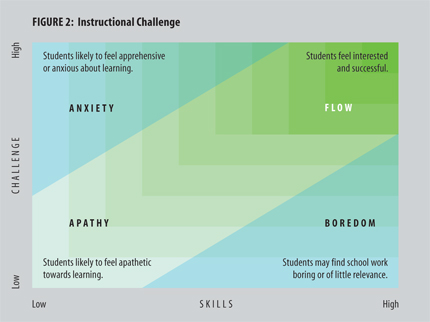
Both concepts have to do with the relation between the difficult of the task (and in some cases the relevance of the task) and the outcome. Hence we read in Brennan, "Too high a Cognitive load decreases a student’s sense of self-efficacy. Too low triggers a boredom threshold that tends to stimulate disengagement."
The two concepts are not exactly the same; there are some important differences that don't really come out in Brennan's presentation, and they play out in educational theory differently. But we can let that pass, and focus on the next step, which (Brennan characterizes as) the relationship between prior knowledge and cognitive load.
Novices in an area have high cognitive loads, and, typically low Prior Knowledge (the idea that what we already know has a powerful determining effect on what we can learn, and how quickly). This is key. It is variable amongst students generally. And it must be flexibly designed for, or we risk failure. Cognitive load and Prior Knowledge are why we tend to teach absolute novices using techniques and contexts that are different to the ones we deploy for absolute experts, and why we avoid exposing novices to too much chaos.In the criticism of connectivism, this argument has two tangible consequences:
First is the suggestion that connectivist courses throw novices into the work at too high a level; there is no scaffolding to help novices learn to follow the information being presented at such complexity and high rates of speed.
Game designers and user experience interface artists know this principles well. One of the major reasons for Google's success is that novices can enter into the system in a very gentle way: they can begin with search, and bit by bit, be drawn into Google's much more extensive ecosystem. Civilization (the game) works in the same way - at the 'novice' level you have advisors to help you, and you can succeed without mastering trade routes and religions, but at the higher levels (like 'deity') you have to manage all aspects of the game.
The problem is, if the educators do this, you lose the ability to do it for yourself. There's nothing more frustrating for me as a learner to find that either (a) the educational designer has thought too little of me, and made the learning too slow and dull, or (b) the designer didn't think of me at all, and didn't provide any introductory guides or starter kits. I've encountered both online, and frequently.
At a certain point in a complex world a learner has to be able to set the bar for him or herself, to set the challenges appropriately, and find the relevant resources. The more an instructional designer does it for you, the less able you are to do it for yourself, and ultimately, the less useful the resource would be. That's why it's better to present the learner with a range of resources around a topic, and have them pick the ones most suited to them, rather than to try to pick the best resource (or to arrange the subject matter into tiers, or any of the usual forms of structured instruction provided in traditional learning).
If Google tried to organize the internet into some sort of 'diffculty level' for you, the results would be endlessly frustrating. The presumption that the instructor or the learning designer is more likely to be able to select material and work at the right level is difficulty is probably misplaced. Every minute spent by any person either bored to tears or frustrated to tears in a traditional classroom is evidence of that fact.
The second consequence is that, in a connectivist environment, there are many distractions (such as the need to navigate all the social software) that add to the cognitive load, making it more difficult even to learn simple elements. "In Connectivism, the distributed platforms, the networked nature of learning, the requirements for metacognition, digital literacy, the new tools and techniques add significantly to the novice's cognitive load."
This has less to do with the 'flow' picture of cognitive load, and more with the idea that there is a limited to the amount of information any person can process, and that therefore any information that is not 'on task' is in a certain sense wasted. This is why we are advised (for example) not to add distracting graphics or background music to educational materials. We can think by analogy of how distracting signs and displays on a highway make it harder to focus on driving safely, especially if they begin intruding into our perspective.
But if this thesis were completely true, there would never be any word problems in mathematics, engineering or physics, because the cognitive load involved in reading the text, comprehending the worlds, and translating them into the theorems being learned are extraneous to the theorems themselves, and hence, make them more difficult to learn.
But we know we need word problems, for two reasons: first, theorems in mathematics, engineering or physics do not exist independently of context, and a full understanding of them involves understanding them as they are applied; and second, learning a theorem isn't simply a matter of remembering it, it is a matter of recognizing when and where it is appropriately applied.
Even the most basic elements of what we learn exist in a network, and therefore their placement in a network, for example, in a social network environment, isn't an accidental and incidental feature of their presentation, irrelevant to their being learned, but is rather an essential feature of the concept, without which it cannot be fully learned at all.
To put the same point even more bluntly - part of what a concept P means is what P means on Twitter, and if you cannot access it on Twitter, then you are unable to fully comprehend what it means. Learning to navigate the social media, the langauge, the conventions and even the idiosyncrasies of a discipline are all part of what it is to learn a discipline; connectivism recognizes this and explicitly accounts for this, while traditional education barely recognizes the concept of context-sensitivity at all.
The Competent Self
Brennan then turns to four ways educators encourage or undermine self-efficacy. The first two are related:
1. Physical and psychological responses - We reassure students, so that their fears, anxieties and uncertainties are, largely, allayed.
2. Encouragement and persuasion - Good educators provide encouragement, and verbal persuasion, which can increase a student’s self-efficacy.These, writes Brennan, are almost completely ignored in connectivism: "Classic Connectivism disregards the theories involved here (constructivism, behaviourism, cognitivism) as outmoded. Educators should be absent, or at most facilitators and not teachers. And peer rewards, or the rewards of social engagement, are not considered to be the primary drivers of motivation."
First of all, as I have so often argued, connectivism is not constructivism - there is no obligation for the educator to be absent, and he or she should feel free to 'teach', to 'preach', or make their presence felt in the course as much as they wish, the only limitation being that this presence is as a participant and not an authority figure.
But more to the point, if people come to depend in general on educators, and only educators, for reassurance and encouragement, then they will be sorely unprepared for life. One of the ways a connectivist course becomes massive is that it eliminates the psychological dependence on the instructor and encourages participants to learn to depend on each other for these necessary supports.
The next two points speaks to the role of the educator in the course:
3. Vicarious experience - our sense of our own capability increases when we see people we consider similar to ourselves achieve at a task.
4. Mastery experiences Mastery experiences provide students with the greatest boost to self-efficacy they will encounter in an educational context.Actually, I think our own sense of capability increases when we see anyone complete the task. This first tells the student that it can be done, and equally important, offers important clues regarding how it can be done.
Traditional educators talk about the value of the worked example, and you can see its application here. It's reassurance that the solution isn't found by magic, that an application of knowledge and method can result in success, and that success has a recognizable form.
This is a role of an educator that I have emphasized a lot - the idea that the role of the educator is to model and demonstrate. The idea here is that the student experiences vicariously success in the field by watching the expert do it, and eventually to do it themselves.
The danger here, though, writes Brennan, is that what the expert does may be too difficult for the novice to master:
"Participants may self-blame, feel inadequate, or possibly, in extreme cases, undergo aspects of depression. Design for experts, and invite novices, and watch novices get shot out of the sky. The burning wreckage you can see trailing off the back as they quit is self-esteem."Agreed. But if you hide the expert performance entirely, you never see the point of the exercise in the first place. You have to show the whole spectrum, from novice performance, to expert performance. It's a lot like a Karate tournament or highland dance competition, where they start with the young children first thing in the morning and continue through the day finishing with the adult championships at a gala in the evening.
But that's exactly what a connectivist course looks like, and exactly what a traditional course does not look like. In a connectivist course, you can see everyone from beginner to master, and all stages in between. When you perform, you perform for everyone. You don't set yourself up to compare yourself only with expert performances, or only peer performances.
And, most importantly, you don't 'design for experts' or 'design for novices'. You create an environment in which all levels can participate with equal facility, where people at lower levels can learn from those who are more experienced, and where people of almost all experience levels (and not just the instructors and experts) can provide examples, advice and encouragement to those just learning.
Novices and Success
Brennan summarizes:
Connectivism, as a theory, generally does not provide support for, or recognition of, prior knowledge, cognitive load, or novice issues, or recognise particular novice needs, even though individual connectivists sometimes do, or try to. It fails to structure experiences to follow that moving target. Its lens does not focus. Difference is blurred, and opportunity is lost. People fail.
The core idea being expressed here is that novices need support of various sorts, and because connectivism does not provide this, or even acknowledge the need, people fail.
Yes, people fail. But I think connectivism actually does a better job supporting the progression from novice to expert stage than traditional learning.
Here's why: connectivism does not treat people as novices their entire lives.
At a certain point, we want people to stop being novices, and to start being self-motivated and self-managing learners. They're going to have to do this in a world where knowledge changes rapidly, where it's less and less certain, and where the availability of formal education or support in an environment can't be counted on.
Ideally, they should stop being novices some time before tenth birthday. They should stop being novices somewhere around the time they able to acquire the ability to read, infer, navigate and socialize.
The idea that we are treating university students and adults as 'novices' is, to my mind, appalling. If a grown adult still requires a teacher to provide encouragement and support, positive role models, to select resources and scaffold learning experiences, then that speaks to the substantial failure of the traditional system of education. To my mind, it is as astonishing a failure as it would be if adults expected their teachers to read the lessons aloud to them.
Failure
This brings us to the final topic, the underlying thread that has permeated this discussion, and yet gone undiscussed: the concept of failure.
Just what is it to 'fail' in a connectivist course? Maybe the problem with Brennan's criticism as a whole is that he is defining forms of success and failure that are not inherent to connectivism at all.
Let's look at his examples of failure:
- The failure to be a node, or the failure to connect - "All of my peers are nodes! Look at them connect! Everyone else seems to be succeeding! Why am I not?... Some people aren't actually nodes. If I type a 140-character message into Twitter and don't know how to use a hashtag, can anyone really hear me tweet?"
We can read, for example, that one of the best predictors of success at an elite university (after getting in) is one's ability to form and work in study groups. Connecting is a necessity in every form of education, but while in traditional education this is learned only tacitly, if at all, it in connectivism it is addressed explicitly.
- Too high cognitive load, and no assurance, or anxiety relieving measures. “New to Connectivism and social media? Here's 300 tweets, 700 Google+ posts in your inbox, 70 blog posts, and a Java-enabled seminar software environment you'll need to calibrate your laptop to access (on a MAC we call that an adventure!), using totally unfamiliar software! Say hello to the LMS too! First task due yesterday, create a digital artefact using a piece of software you've never encountered!”
The rational response to so much data is, first, don't read it all, and second, don't think yourself a failure if you haven't. The idea is to pick and choose, to focus. This is the first skill in any discipline - it is what helps us understand what is important and what is just noise. Children learn this, but somehow, by the time we're adult educators, it has been trained out of us.
Every single connectivist course I have ever offered has begin with advice about what to do with so many posts and messages. It's the first thing you read.
It isn't failure if you don't read everything, if you don't do everything. That's a very industrialist consumption-based model of learning (and of the world generally). Success or failure is found in the quality of the experiences you do choose to have, and are reflected in your own assessment of yourself, not against some arbitrary and impossible external standard.
- Decentralise the learning process to a degree where clarity and structure require skills you don't have to access the information you need. “Four different platforms! The information is out there! Somewhere! Choose your own path to it! In Connectivism, no one can hear you scream! (If you don’t tweet it with #helpImdrowninginthefreedom)”
The more pressing question is why your desire for 'clarity and structure' require that things be more or less centralized, and already organized for you. the very first lesson of Taoism is that all such organization is artificial and contrived, so you may as well learn to seek and master organizing the world for yourself.
Four different platforms? At least they're all in a computer - can you imagine if you had to navigate the intricacies of a cafeteria, a gymnasium, a scientific laboratory and a theatre all in the same day! Oh, wait...
More seriously - an inability to navigate across different websites is a form of literacy, analogous to being able to live in a city, go from classroom to classroom in a school, or read English as written by four different authors. Except that - you don't have to navigate four platforms. Connectivism is about choice. If it really bothers you, pick one platform and stick with it.
The presumption here is that there is some McGuffin, 'the information', that is Out There Somewhere. But that presumption is mistaken. Each person is expected to have a different experience, which may be as broad or as narrow as they choose, and whatever 'structure and clarity' they achieve is based on that experience - and not somehow 'wrong' if it doesn't encompass all perspectives on all platforms.
- Tasks that are too complex with no guidance in how to achieve them. “Everyones a node! Connect to learn! Setup your blog, crosspost to Google+ and socially curate to Diigo while using Audacity to post a podcast to Tumblr! That’s updated on Twitter! I’ve done my bit. Now learn!”
The problem here is one of mistaking a menu for an obligation. Sure, in traditional education, we've acquired this sense that anything set before us by an instructor is a requirement (and will be on the test, otherwise, why would it be presented?) but in a connectivist course such items are, at best, suggestions.
Brennan says, "if we unlearn the hard fought lessons of the past we fail our learner." But it would be easier all around, especially for the learners, if the learners would unlearn the 'lessons' inflicted on them by teachers who through they were doing good, but who were leaving their students woefully unable to cope with a 21st century world.
Connectivist Literacy
Brennan to the contrary notwithstanding, we have thought about these things, written about them, even offered a course (Critical Literacies) in them, to explore how connectivist literacies can be developed employing connectivist methodologies.
"Connectivism’s assumptions -- we are all digitally literate nodes, knowledge is in the network, we are all motivated, have good learning strategies, and information sifting abilities, and can cope with multi-platform information streams, in an environment where instruction is at most facilitative, but probably absent -- mean that the sensitive design of experience that engages prior knowledge, motivation, confidence level, and student need is absent, and not possible."
These aren't assumptions. They are literacies. They are to connectivism what reading and writing and 'rithmetic are to a traditional content-based education.
And - in my view at least - a connectivist approach is uniquely able to develop them in people as literacies.
The key is to stop thinking of these as content to be mastered, and to start thinking them as skills to be practiced. There isn't some point of success or failure in any of these, you just do them - like talking to your friends, like walking from class to class - until it becomes second nature.
Indeed, so long as you think of knowledge and learning as something to be acquired and measured and tested - instead of practiced and lived and experienced - you will be dissatisfied with connectivist learning. And - for that matter - there's probably a limit to how far you can advance in traditional education as well, because (to my experience) everybody who achieves a high degree of expertise in a field has advanced well beyond the idea that it's just information and skills and things to learn. Kind of like Dreyfus and Dreyfus said.
Anyhow, that's all for today.